




What Are Digital Marketing Hiring Managers Really Looking for in 2026?
The digital marketing job market in Indonesia is in an uneven state. On one side, demand for professionals keeps rising, LinkedIn reports a 63% growth in job postings over the past two years. On the other, hiring managers across companies are finding it increasingly difficult to find candidates who are genuinely work-ready. Not because there are too few applicants. Quite the opposite.
The surge of online courses, free certifications from Google and Meta, and educational content on YouTube has produced a large wave of candidates claiming to have mastered digital marketing. Yet when faced with real-world case studies, many fall short, not because they lack intelligence, but because there is a fundamental gap between what they have learned and what the industry actually needs.
This article takes a specific look at what digital marketing hiring managers are truly evaluating in 2026 from the first signals they look for in a CV, to the interview questions that most often eliminate candidates at the final stage.
Why Digital Marketing Hiring Standards Have Risen Sharply in 2026
Three structural shifts happened simultaneously over the past two years, and each one has directly raised the bar for recruitment. First, AI has automated basic execution-level tasks. Writing captions, scheduling posts, even generating weekly performance reports can now be done by AI tools in minutes. As a result, roles that once required a full-time person can now be handled by one person working with AI. This means hiring managers are no longer looking for executors, they are looking for someone who can direct AI and interpret its outputs.
Second, platform fragmentation has created higher complexity. The digital marketing ecosystem now extends far beyond Google and Meta, encompassing TikTok, Tokopedia Ads, Shopee Ads, YouTube, and AI platforms like ChatGPT Search and Perplexity. Managing strategy across this ecosystem requires a far more systematic mindset than it did two or three years ago.
Third, the C-suite increasingly demands data-driven accountability. The era of “high engagement but unclear conversion” is over. Marketing is now expected to prove its direct, measurable contribution to revenue. Hiring managers are searching for candidates who can speak the language of business, not just the language of platforms.
7 Things Hiring Managers Look for First in a Digital Marketing CV
Before an interview even begins, an initial judgment is formed within the first 30 to 60 seconds of reading a CV. Here are the seven elements that most commonly determine whether a candidate advances to the next stage.
1. Specific Numbers, Not Generic Claims
The difference between a CV that passes and one that does not often comes down to one thing: numbers. “Improved SEO performance” means nothing. “Grew organic traffic from 4,200 to 18,700 sessions per month over six months” is the kind of statement that makes a hiring manager stop and read again.
Candidates who are already accustomed to working toward measurable targets and documenting results, whether in a job, freelance work, or a structured learning program, consistently outperform others at this initial screening stage.
2. A Verifiable Portofolio
Certifications from major platforms are noted, but they rarely serve as a true differentiator. What genuinely stands out is a portfolio of real projects — landing pages managed, ad campaigns executed, analytics reports authored, or content published alongside its performance data.
The easier that portfolio is to verify (a live URL, a dashboard screenshot, an accessible report) the more trust it generates.
3. Depth in at Least One Area
No one expects a fresh graduate to master every channel at once. However, hiring managers want candidates who have genuine depth in at least one area, paired with a conceptual understanding of how that area interacts with the rest of the marketing mix.
A candidate who simply lists “proficient in SEO, SEM, social media, content marketing, email marketing” without concrete evidence for any of them is actually sending a negative signal.
4. Experience with Tools the Industry Actually Uses
Google Analytics 4, Looker Studio, Meta Ads Manager, Google Search Console, Semrush or Ahrefs, HubSpot or Mailchimp, these are baseline tools expected to already be familiar, not to be learned from scratch after joining.
5. A Consistent Career Narrative
A CV that shows logical progression from junior to more senior roles, or from generalist to specialist, is far more convincing than one that appears to jump around without a clear thread connecting the dots.
6. A Full-Funnel Understanding
Candidates who only understand one point in the funnel (for instance, who know how to create awareness-stage content but do not understand how that content contributes to conversion) will struggle in companies that expect marketing to operate across the entire funnel.
7. An Online Presence Consistent with Their Claims
This is frequently overlooked, hiring managers check LinkedIn, portfolio websites, and even Google. A candidate claiming expertise in “personal branding” whose own profile is sparse will immediately raise questions.
The Most In-Demand Digital Marketing Skills and the Rarest
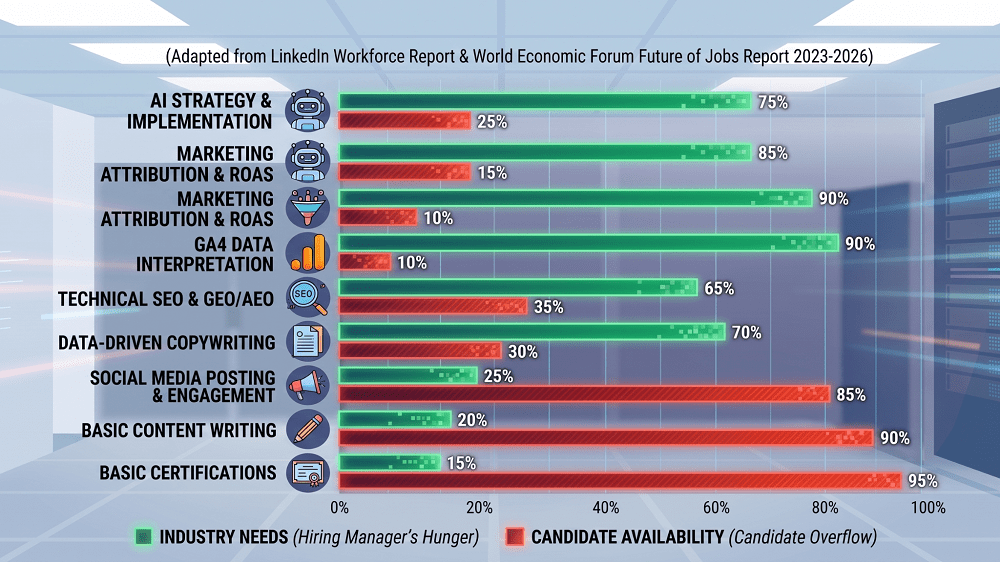
Digital marketing skills gap: Candidate availability vs industry needs 2026
Based on an analysis of over 500 digital marketing job listings in Indonesia in the first half of 2026, a very clear pattern emerges between skills that appear frequently in postings and skills that are genuinely hard to find.
The following skills are most commonly required across all mid-to-senior level listings:
- Marketing analytics and data interpretation. The ability to read GA4, build actionable reports, and make data-driven decisions, not merely take screenshots of dashboards.
- Paid media management. Not just “able to run ads,” but capable of managing budgets, iteratively optimizing campaigns, and justifying decisions based on ROAS.
- SEO beyond keywords. This includes technical understanding (crawlability, site speed, structured data), content strategy, and sustainable link building.
- Content strategy. Distinct from content writing. This means the ability to map content to the funnel, identify gaps, and measure the impact of content on the pipeline.
The following areas represent the widest gap between market demand and available talent, the rarest and most valuable skills:
- Genuine marketing attribution. Being able to answer the question “which channel contributed most to revenue this month, and why?” using the right attribution model is a skill that is extremely rare, even among experienced candidates.
- Understanding AI in a marketing context. Not simply using ChatGPT to write copy, but understanding how generative AI is reshaping consumer search behavior and how marketing strategy must adapt. This includes a foundational grasp of how brands can be cited by AI platforms, which is becoming a new metric in the digital ecosystem.
- Data-driven copywriting. Combining strong writing ability with A/B testing, heatmap analysis, and conversion-based iteration, not just creative instinct.
- Presenting to non-marketing stakeholders. Communicating campaign results, requesting additional budget, or making the case for a new strategy to a CFO or CEO. This is the competency that most clearly separates mid-level and senior marketers.
- Developing a comprehensive understanding of the full digital marketing skills landscape (which are foundational, which are specialized, and which are emerging) is an important starting point before deciding where to direct your learning investment.
The Interview Questions That Most Often Eliminate Candidates
The interview stage is where many candidates who look strong on paper actually fall out of the process. Not because they lack knowledge, but because they cannot apply that knowledge in a specific context.
-
Questions About Failure
For example: “Tell me about a campaign that did not go as expected and what you learned from it.”
Candidates who have never worked on real projects will struggle to give a substantive answer. Hiring managers are not looking for candidates who have always succeeded, they are looking for candidates who know how to analyze failure and iterate.
-
Case Studies with Resource Constraints
For example: “You have a budget of IDR 5 million per month, and the target is a 30% increase in qualified leads within three months. How would you allocate and execute?”
There is no single correct answer. What is being evaluated is the candidate’s framework: do they start from data (industry benchmarks, customer personas), do they weigh trade-offs between channels, and do they know how to measure success?
-
Question About Current Trends
For example: “How has the shift in consumer search behavior driven by AI affected your content strategy?”
This is a litmus test that is increasingly common in 2026. Candidates who do not actively follow industry developments will struggle to give a substantive answer.
-
Question About Cross-Team Collaboration
For example: “How do you typically work with product or sales teams to ensure marketing campaigns have a real impact on revenue?”
Marketing does not operate in a silo. Hiring managers are looking for candidates who understand that lead quality, sales cycle length, and customer lifetime value are shared responsibilities, not solely the concern of the sales team.
Different Expectations by Seniority Level
Understanding what is expected at each level helps candidates position themselves more accurately.
| Dimension | Entry Level (0–2 years) | Mid Level (2–4 years) | Senior Level (4+ years) |
|---|---|---|---|
| Primary Focus | Accurate and fast execution | Ownership of a channel or project | Cross-channel strategy and revenue accountability |
| Critical Skills | Tool proficiency, attention to detail | Data analysis, iterative optimization | Marketing attribution, stakeholder management |
| What’s Most Valued | Real project portfolio, growth mindset | Campaign track record with measurable numbers | Ability to build systems and manage teams |
| Biggest Red Flag | Cannot distinguish theory from practice | Cannot explain decisions using data | Has no vision for the direction of the industry |
How the Best Candidates Prepare
Based on recruitment patterns that emerged throughout 2025 and 2026, there are consistent characteristics that appear among the candidates most sought after by leading companies.
They have documented real projects. These do not need to come from a formal job. Freelance work, a personally managed and optimized blog, or a campaign run for a non-profit organization are all valid, as long as the results are documented with verifiable numbers.
They learn within a structured ecosystem. Candidates who have gone through intensive learning programs, such as a digital marketing bootcamp designed around industry competencies, tend to have a more systematic understanding of how each component of digital marketing connects to the others. This becomes immediately evident when they tackle case study questions.
They actively follow industry developments. Industry newsletters, annual reports from major platforms, discussions in professional communities. The best candidates do not learn only when preparing for interviews.
They can explain the why, not just the what. The difference between a candidate who has memorized best practices and one who genuinely understands the principles behind them becomes clear the moment questions move beyond what is in the textbook.
Trends That Will Define the Next Twelve Months
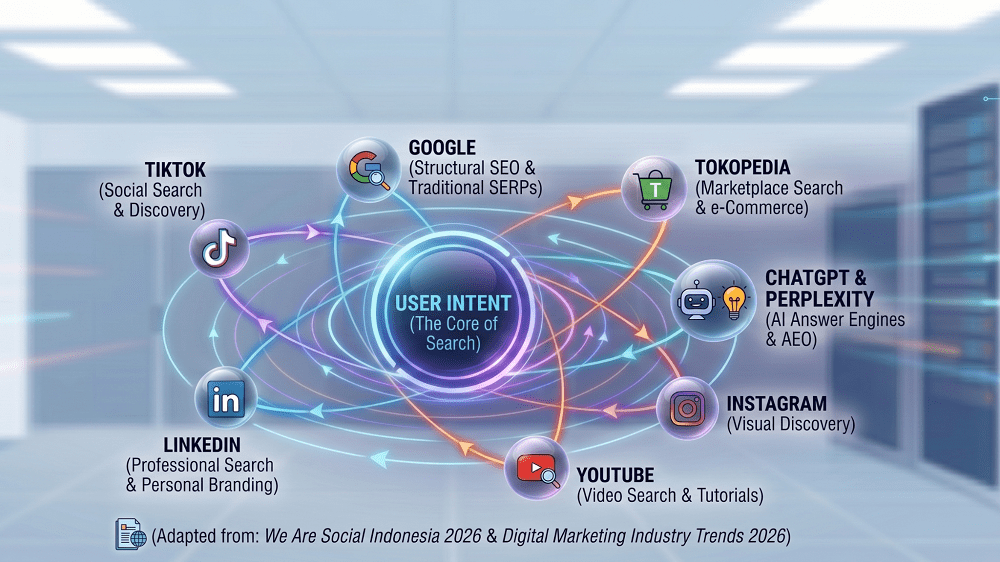
The 2026 “Search Everywhere” ecosystem across multiple digital platforms
Several shifts deserve attention from anyone building a career in digital marketing:
-
T-shaped skills are becoming the standard
Companies are no longer looking for pure generalists or pure specialists. The most sought-after candidates have genuine depth in one or two areas, paired with functional understanding across the rest.
-
AI literacy is becoming baseline
Within the next 12 to 18 months, the ability to use AI tools in marketing work will no longer be a value-added skill, it will be a basic prerequisite. What will differentiate candidates is the ability to use AI strategically, not merely operationally.
-
Demonstrated results are replacing certifications
Certifications remain relevant as a signal that a candidate has foundational knowledge. But a portfolio backed by measurable proof is taking an increasingly larger share of the weight in hiring decisions.
-
Specialization in AI-expanded areas will be highly valuable
Areas such as marketing analytics, conversion rate optimization, and content strategy for AI search (GEO/AEO) are among the fastest-growing segments and the hardest to fill with currently available talent.
The Gap Is Not in Knowledge, It Is in Proof
Digital marketing hiring managers in 2026 are not short of candidates who know the theory. What they are looking for and rarely finding is candidates who can prove they know how to apply it in real conditions, with limited resources, and produce measurable output.
It is not about having the most certifications or attending the most expensive course. It is about having a concrete portfolio, a systematic way of thinking, and the ability to communicate the value you bring to a team.
For anyone building the foundation of their career in this field, one question is worth keeping as a guide “can what I am learning today be proven with numbers tomorrow?”
The answer to that question is the difference between a candidate who gets invited to interview and one who never receives a reply. If you want to start building the right foundation, tempatbelajar.id offers learning pathways designed directly from industry needs, not just a list of common topics.
For other marketing methods, you can download these two e-books at the following link:
Do you need a marketing plan?
Related Posts :
 Exploring the World of Influencer Marketing:…
 Digital Marketing Jakarta: Effective Strategies to…
 Implementing Digital Campaigns: The Key to Success…
 Black Shadow in Digital Marketing: Unraveling the…
 Digital Agency Jakarta: The Best Solution to Grow…
 Digital Agency Indonesia: A Real Partner for Growing…
 Affiliate Marketing: Increase Sales and Build…
 Are Digital Agency Services Still Needed Today?

Sorry, the comment form is closed at this time.